
Emotionally Exhausted From Carrying Everyone? Here's What Nobody Tells You
Are you the woman everyone leans on, but no one thinks to check on?
You remember the appointments, the birthdays, you track the feelings of everyone in the room. You keep the relationship going, the family functioning, everyone’s emotional energy regulated. And you do it so consistently, and so quietly, that nobody even notices or questions it anymore.
And that is exactly the problem.
Why the Strong One Always Ends Up Exhausted
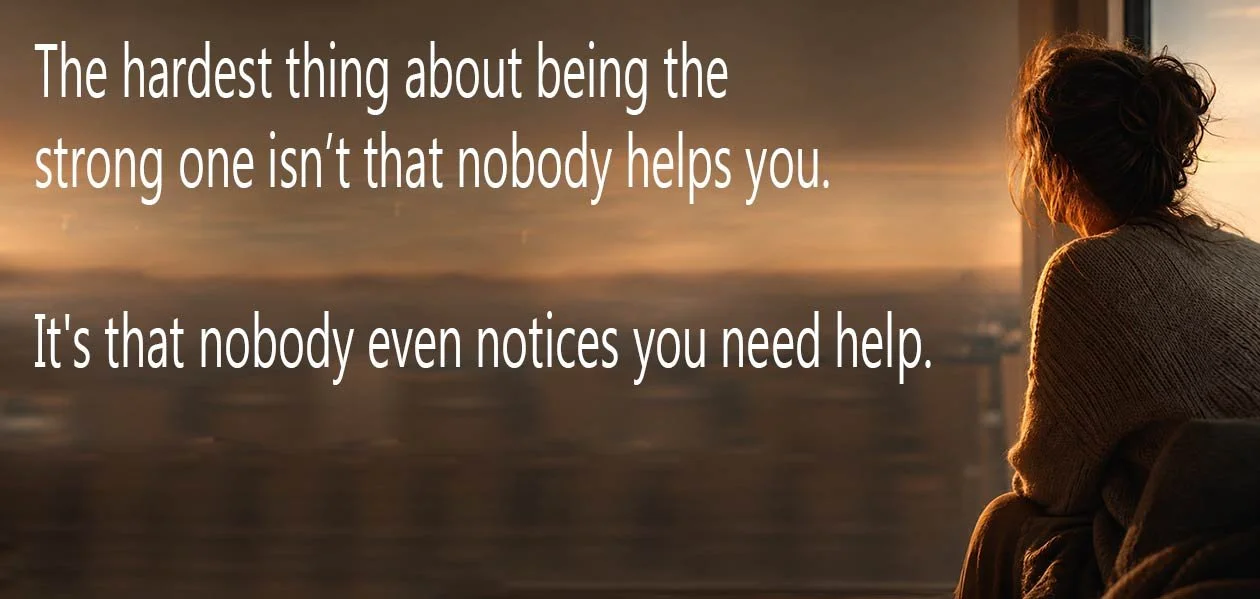
The hardest thing about being the strong one isn't that nobody helps you, it's that eventually, nobody even notices you need help.
Over time something strange happens - the more you carry, the less people see, the more you manage, the less anyone notices what it costs you, the more you give, the less anyone asks what you need.
Not because the people around you are cruel, but because your competence has become part of the furniture - expected, relied upon and invisible.
If you are always the one who holds everything together, the relationship, the family, the household, the emotional needs of everyone around you, and you are starting to wonder how much longer you can keep going, you are not alone in this. This is one of the most common patterns I see in women who come to my therapy room, and it has a name: overfunctioning.
What Is Overfunctioning and Do You Recognise It?
Overfunctioning means consistently carrying more than your share, emotionally, practically, relationally, while others around you carry less. It often looks like this:
You cannot switch off, you are always anticipating the next problem, the next need, the next thing that needs managing. You feel responsible for other people's emotions, if someone in the room is uncomfortable, you feel compelled to fix it. You find it almost impossible to ask for help, or to receive it when it is offered, you may also find it difficult to express your needs or even to admit that you have them. You tell yourself you are just being capable and loving, but underneath, you are exhausted and running on empty.
Women who overfunction are often described by others as amazing, so strong, I don't know how she does it. Inside, they are exhausted, resentful, and quietly wondering when it will be their turn to be taken care of.
The Question That Changes Everything
At some point, and usually after years or decades, not weeks or months, a question surfaces that many women feel ashamed of, “If I stopped carrying all of this, who would notice?"
This question isn’t self-pity, nor ingratitude or self indulgence . It is one of the most honest questions a woman can ask herself, because it points directly to something real - a pattern that has been running, often since childhood, that says your value lies in what you do for others, not in who you are.
If you have found yourself Googling things like ‘why do I always have to do everything’, ‘why am I always the one who cares more’, or ‘why can't I stop people pleasing'‘, this is likely the pattern running underneath all of it.
Where People Pleasing and Overfunctioning Start
Overfunctioning rarely starts in adulthood, it usually begins in a family system where a child learned early that being loved meant being needed, or useful. That being capable kept the peace in the home, that having needs of your own was unsafe, inconvenient, or simply not an option.
The child who learned to read the room grows into the woman who manages the room. The child who suppressed her own needs to keep a parent calm grows into the woman who cannot receive care without feeling uncomfortable.
This is not a character flaw, it is a childhood survival strategy that has now outlived its usefulness, and it is one of the most treatable patterns in therapy - when you work at the right level, in the subconscious.
Why Talking About It Is Not Enough
Most women who come to me have already tried talking about it, and they may understand, intellectually, where it comes from. Often, they can trace it back to a parent, a family dynamic, a childhood role. They can name it clearly or at least recognise that it exists.
And yet nothing changes.
That is because understanding a pattern and changing a pattern are two entirely different things. People pleasing, overfunctioning, the inability to receive, these do not live in the thinking mind, the conscious mind, they live in the subconscious. And this is precisely where standard counselling and talk therapy often cannot reach.
If you have spent years in therapy or counselling and still find yourself falling back into the same patterns, this is why. Insight alone does not rewrite a subconscious programme, it needs to be addressed at the root - in the subconscious mind.
A Faster Way to Change Deep Patterns, Without Years of Therapy
What I specialise in is getting quickly to the pattern beneath the behaviour, the subconscious belief or wound that is driving it, and working to change it at the level where it actually operates.
By combining advanced behavioural strategies with deep psychological work, this approach moves significantly faster than conventional counselling or CBT because it transforms patterns rather than just analysing them. It goes to the root and works directly with the subconscious mind, where the pattern was formed and where it continues to run.
Many clients notice a real shift from the very first session, not just understanding what the pattern is, but feeling something actually change.
This is not about positive thinking or surface-level coping strategies, it is about identifying the exact belief driving the behaviour and updating it at source.
Therapy for Women Who Are Exhausted, Online and In Person
I work with women who are exhausted by their own competence, who have spent years being everything to everyone and have quietly lost the connection with themselves.
I offer both online therapy and in-person sessions at my therapy space in Crossmaglen, South Armagh, just four minutes from the North Monaghan and Louth borders, a short distance from Castleblayney, Carrickmacross, and Newtownhamilton. In-person clients can travel from Dundalk and Newry, both approximately twenty minutes away.
Online sessions are available to clients across Ireland, Northern Ireland, the UK, and worldwide.
Whether you are searching for a therapist near Newry, counselling in Monaghan, therapy for burnout in Dundalk, or online therapy for over functioning women and people pleasers anywhere in the world, this work is available to you.
You Do Not Have to Keep Carrying This Alone
The most capable woman in the room still deserves support, and especially her.
If you recognised yourself in these words, that recognition matters, you aren’t weak, you are at the beginning of something.
Not sure where to start? Book a free consultation and we'll figure it out together.
It's a straightforward conversation by phone or online, a chance to talk about what you've been experiencing, ask questions, and see whether working together feels right for you.
There's no pressure and no obligation, just a conversation.
With kind regards, Geraldine
You can text or whatsapp me on 00447379262151
Email me at geraldinefaytherapy@gmail.com
Or book a convenient time directly on my booking calendar below;
