
You Learned to Be Accommodating, Emotionally Self-Reliant, and Hyperaware
People pleasing, emotional self reliance, and hyper vigilance are often rooted in fight, flight, freeze, or fawn responses. This post gently explores how these nervous system patterns develop as ways of staying safe in childhood, how they become familiar over time, and why they can linger into adulthood, long after the original threat has passed.
I’ve intentionally written this piece in simple bullet points, with plenty of space to pause, so the ideas can land gently and be taken in at your own pace, without pressure or overwhelm, sincerely Geraldine.
How Childhood Patterns Shape Adult Attachment
Do you ever feel like you’re always adjusting, always adapting, just to keep relationships calm?
If so, you may have grown up learning that being accommodating (people pleasing), emotionally self-reliant, and hyperaware was the safest way to belong, to receive acceptance and love.
These patterns aren’t flaws. They are survival strategies, formed early and quietly, in childhood. And they often show up in adult relationships as attachment issues, emotional exhaustion and a persistent feeling of being “too much” or “not enough.”
In this post, we’ll explore how childhood coping strategies shape adult attachment styles. The goal of healing is not to erase your coping strategies, it’s to explore them, understand what they protected you from, and gradually change the behaviours that no longer serve you.
What Are Childhood Patterns?
Childhood patterns are learned behaviours that helped you survive your emotional environment.
Pattern behaviours can include:
People pleasing
emotional independence
constant vigilance
perfectionism
These patterns usually start in childhood but continue into adulthood, where they can create relationship challenges and self-worth issues. What helped you survive and cope in childhood often causes unhelpful behaviour and self sabotage in adulthood.

The Core Childhood Strategies That Shape Adult Attachment
Most people don’t rely on a single coping strategy. Instead, they develop a range of strategies that work together, unconsciously switching between them depending on the situation, the people involved, and how threatened or overwhelmed they feel. Over time, these strategies become automatic and shape how we relate to others as adults.
Such strategies include;
1. Being Accommodating to Stay Connected
This pattern forms when a child learns that harmony matters more than honesty.
Love feels safest when:
you don’t cause conflict
you’re agreeable and helpful
you adapt to others’ needs.
As an adult, this often becomes:
self editing
prioritising others over yourself.
The issue: You may lose touch with what you actually want and, over time, may come to believe that your needs are a burden.
Core belief: “Connection depends on me not causing problems.”
2. Being Emotionally Self Reliant to Stay Safe
This pattern forms when emotional support is inconsistent.
It shows up when:
caregivers / parents are emotionally unavailable
needs are met practically but not emotionally
emotional vulnerability felt risky.
As an adult, this can look like:
difficulty asking for help
minimising your struggles
pride in handling things alone.
The issue: Self reliance can become a shield against disappointment and also a source of loneliness.
Core belief: “Relying on others is risky.”
3. Being Hyperaware to Maintain Stability
When emotional environments are unpredictable, children become excellent observers, developing hyperawareness of others.
They learn to:
read tone and mood in others
anticipate emotional shifts
manage themselves to prevent disruption.
The issue: Hyperawareness can become exhausting. It can lead to over-thinking, anxiety, and self-blame.
Core belief: “Stability requires me giving my attention to others.”
4. Being Useful to Feel Valued
In some environments, worth becomes tied to achievement, the child must be useful to others in order to receive acceptance or love.
As an adult, this can show up as:
perfectionism
high standards
pressure to “earn” love
feeling undeserving of rest when tired.
The issue: Your value feels conditional. Needed rest or downtime feels like something you must earn.
Core belief: “My value is dependent by how much I do for others.”
How These Patterns Become Attachment Styles
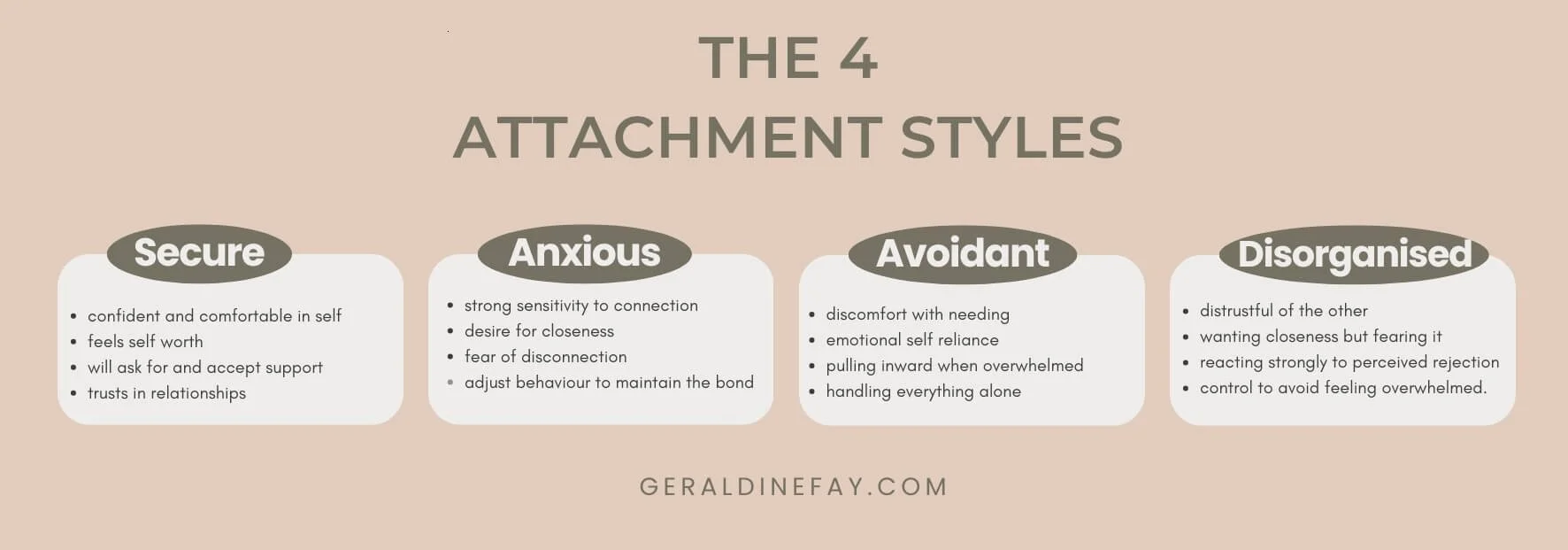
Attachment styles describe how we relate to others in the context of closeness, distance and emotional dependence, especially under stress. This combination of patterns often maps to fearful-avoidant (disorganised) attachment, with a leaning towards anxious.
Anxious attachment
strong sensitivity to connection
desire for closeness
fear of disconnection
tendency to adjust behaviour to maintain a bond with the other.
Avoidant attachment
discomfort with needing
emotional self reliance
pulling inward when overwhelmed
managing internally rather than reaching out.
Disorganised attachment
feeling distrustful of the other, without cause
push pull, wanting closeness but also fearing it
reacting strongly to perceived rejection, even if small or unintentional
strong need for control in relationships to avoid feeling overwhelmed.
The inner conflict
“I want closeness but I don’t want to need.”
Many people hold both anxious and avoidant attachment patterns, which creates a push–pull tension: “I want closeness, but I don’t want to need.” You may crave connection but pull away when it feels risky, or try to stay self-reliant to avoid disappointment. These patterns are survival strategies that can become automatic, shaping how you relate to others in adulthood, in friendships and relationships.
How This Shows Up in Adult Relationships
In relationships (family, friends and intimate) this behaviour pattern may mean that you;
give more than you receive
sense emotional shifts before they’re spoken
delay expressing your needs until they feel become urgent
feel that your needs are not important.
Under stress you may;
in the first instance, manage your behaviour to suit others
secondly, stabilise the environment
lastly, ask for help.
In conflict you may;
aim for calm and resolution over your own needs
alter your truth to preserve connection
hold resentment internally over time.
Most often, others experience you as capable and emotionally intelligent, while inwardly you feel unseen or quietly exhausted.
The Cost and the Strength of this Pattern
The cost of this pattern isn’t that it’s wrong. The cost is that it asks too much of you.
But it also created real strengths, such as;
deep empathy
emotional insight
reliability
adaptability
a strong capacity for intimacy when safety is present.
These qualities don’t need to be unlearned, but they do need to be rebalanced more in favour of yourself first and others second.
Moving Toward Secure Attachment
Healing isn’t about becoming less caring or less capable, its about;
expressing your needs earlier (and not always perfectly)
allowing others to respond imperfectly
staying present instead of disappearing inward
trusting that connection can survive your honesty.
A simple reframe: “I don’t have to disappear to stay connected.”
Secure attachment isn’t something you either had or didn’t have. It’s something you can build through awareness, boundaries, and relationships that can hold your full and true self.
Final Thoughts
Your childhood patterns were solutions to your environment.
They helped you belong.
They helped you cope.
They helped you grow.
They helped you survive
But now you get to decide which ones still serve you and which ones you’re ready to soften or let go of.
That choice isn’t a rejection of who you were, it’s an expansion of who you’re becoming.
Taking the next step
If any part of this resonated, you don’t have to hold it on your own. I’m Geraldine, an integrative therapist, and I work with people who have learned to be accommodating, emotionally self-reliant, and hyperaware as a way of getting through. Therapy can be a space to slow down, feel supported, and gently unlearn what no longer serves you. I meet with clients both online and in person in Crossmaglen, Co. Armagh.
Start With a Conversation
If you recognise yourself in this, you’re welcome to begin with a free, no obligation conversation where we can talk about what’s been coming up for you, explore what you need right now, and see whether this kind of work feels right.
You don’t need to prepare anything.
Just come as you are.
When you are ready, you can book your free consultation below.
